skip navigation

This page is designed for modern browsers. You will have a better experience with a better browser.

Brown Home Brown Home Brown Academics


Jan Hesthaven

Professor of Applied Mathematics:
Applied Mathematics
Phone: +1 401 863 2671
Jan.Hesthaven Brown.EDU

Ph.D., Technical University of Denmark, 1995

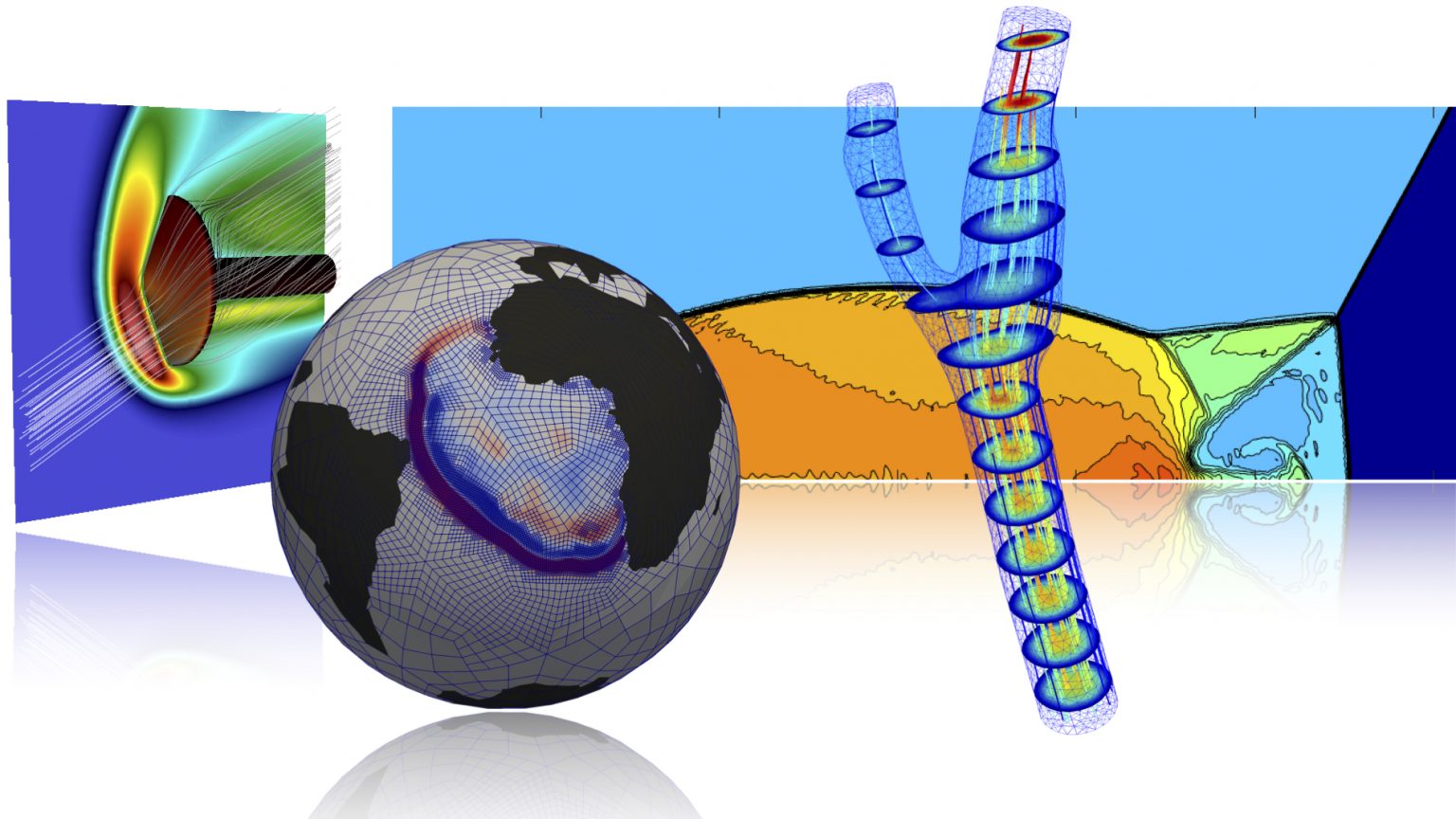
The research interests of Prof Hesthaven can broadly be defined as the development, analysis, and application of high-order accurate methods for the solution of partial differential equations. Particular emphasis is on high-order finite difference and spectral methods, spectral element and discontinuous Galerkin methods, in particular for problems in complex geometries, Applications include gas dynamics, electromagnetic scattering, micro optics and photonics, plasma physics, and cosmology.

Biography

Professor Hesthaven recieved an M.Sc. in computational physics from the Technical University of Denmark (DTU) in August 1991 and a Ph.D. in Numerical Analysis from the Institute of Mathematical Modelling (DTU). Following graduation in August 1995, he was awarded an NSF Postdoctoral Fellowship in Advanced Scientific Computing and was approinted Visiting Assistant Professor in the Division of Applied Mathematics at Brown University. In December of 1996, he was appointed consultant to the Institute of Computer Applications in Science and Engineering(ICASE) at NASA Langley Research Center (NASA LaRC). As of July 1999, he was appointed Assistant Professor of Applied Mathematics, in January 2003, he was promoted to Associate Professor of Applied Mathematics with tenure and as of July 2005, he was promoted to full Professor.

In September 2000 he was awarded an Alfred P. Sloan Fellowship, in July 2001 he was awarded a Manning Assistant Professorship, and in March 2002, he was awarded an NSF Career Award. In recognition of his teaching he was, in May 2004, awarded the Philip J. Bray Award for Excellence in Teaching in the Sciences (the highest award given for teaching excellence in all sciences at Brown University).

Professor Hesthaven is on the editorial board of Journal of Scientific Computing (2003-) and the SIAM Journal of Scientific Computing (2005-). He is a permanent member of the scientific committee of several international conferences and serves as a reviewer for numerous journals and for both national and international funding agencies.

Interests

CENTRAL RESEARCH INTERESTS

A unifying topic of my research activities has been the development, analysis, and application of high-order accurate methods for the solution of time-dependent partial differential equations with a particular emphasis on conservation laws. The majority of my research efforts are centered around classic areas of the numerical analysis of such methods, i.e., problems associated with accuracy, stability, efficient solvers, robustness etc, as well as large scale applications of such methods.

Until a few years ago, the use of high-order methods was restricted to a small community due to number of problems which have found robust solutions only in the last decade and in the development of which I have been involved. As evidence of the recent rapidly expanding interest in such techniques one can note that more than 250 people attended the last International Conference on Spectral and High-Order Methods (ICOSAHOM), co-organized by me and held at Brown in summer 2004. This is more than twice the attendance of the previous ICOSAHOM which took place in Uppsala in the summer of 2001.

What separates high-order accurate methods from more classic computational techniques, e.g., finite element, finite volume, or finite difference methods, is the inherent assumption of global smoothness that allows one to very accurately approximate solutions using global expansions, i.e., Fourier series or high order polynomials are classical examples. This results in highly efficient computational methods for problems with smooth solutions and this was the original area where these methods were used, e.g., incompressible fluid flows. However, one easily shows that the benefits of using high-order methods become increases when one considers time dependent problems as they offer superior control over error growth.

The classic concerns raised about the use of high-order and spectral methods are that the nature of the global expansion and the assumption of smoothness essentially restricts the use of such techniques to smooth problems in simple domains. Addressing these exact concerns has occupied me during the last decade and a number of techniques to overcome these restrictions have been developed.

Geometric flexibility is most naturally ensured through a multi-domain ormulti-element formulation. However, this approach shifts the key question to how one develops and imposes proper patching conditions between the local solutions in a consistent, time stable manner, and computationallyefficient way for general conservation laws. The key developments here are found in the analysis of wellposedness of the PDE's at the continuous level to derive the correct boundary operators and the use weakly or asymptoticallyimposed boundary conditions, known as penalty methods in spectral methods,SAT methods in high-order finite difference methods and, as a very popularspecial case, discontinuous Galerkin methods. This results in fully general, discontinuous element methods on Galerkin or collocation method-of-lines form, well suited for general geometries, adaptivity, parallel implementations etc. Furthermore, the additional freedom recovered by relaxing the boundary conditions enables a constructive approach to stability, and the fundamental separation between the interior operators and the boundary operators offers exciting new opportunities to develop preconditioning
techniques etc

In a number of papers, I have, with several co-authors, developed these techniques from a very basic initial idea in the late 1980'es to mature computational techniques for a variety of problems, e.g., compressible Navier-Stokes equations, Maxwell's equations etc, and analyzed such schemes for stability as well as accuracy. This has lead to schemes which have full geometric flexibility, a substantial stability theory, and with several examples of implementations. More importantly, they allow for the use methods at arbitrary order, thus enabling the choice of order best suited to solve a particular problem at a given tolerance in minimum time. In several papers we show how to make this trade off in the most appropriate way.

While the early developments of these techniques were centered around the use of curvilinear hexahedra as the main geometric building block, such methods are somewhat restricted by the difficulty associated with automatic grid generation based on hexahedra.

Thus, early on I began looking at computationally efficient high-order accurate ways of representing solutions efficiently on general element types, in particular simplexes. This lead to the development of high-order nodal elements based on genuine multivariate Lagrange polynomials in which the associated grid points are computed as a minimum energy solution to an electrostatic problem. With further developments, this has led to the formulation of high-order accurate families of computational methods for general conservation laws, discretized on fully unstructured grids. During the last few years we have demonstrated the efficiency, robustness, and accuracy of methods for variety of problems, e.g., gas- and fluid flows, electromagnetics, and free surface flows.

The development and analysis of high-order methods for solving conservation laws in complex geometries continues to occupy a cornerstone in my research efforts. However, in more recent papers I have also considered in some depth the questions of how to use high-order methods for problems of limited regularity. The standard technique here, both for stabilization and accuracy recovery, is that of filtering and we have recently offered the first thorough analysis of this for polynomial methods. Another technique which we have recently considered is postprocessing and filtering by Pade reconstruction.

Along side these main activities, I have been involved in a variety of related efforts over the last decade. In particular, I have spend considerable effort on the analysis and further development of novel absorbing layers, known as perfectly matched layers, to accurately model problems in open domains. This has led to new methods for both advective acoustics and electromagnetics.

Another interesting development is that of embedded finite difference methods, e.g., methods where one locally alters the stencil to enable the use of simple grids even for geometrically complex problems. The key concern here is how to accomplish this in a time stable manner and to the order of the interior scheme. In a few papers, we demonstrated how to accomplish this for Maxwell's equations in a 2nd order scheme, offering the first stability analysis of such methods. Recent work also includes attention to 4th order schemes although a general multi-dimensional approach for this remains an open challenge.

Yet another activity is that of adaptivity and error estimation for dynamic problems. My work here has focused on the use of wavelets to provide reliable local error and smoothness estimators on which one can subsequently decide how do adapt the grid and/or the local order of the method. These methods appear promising although we are currently exploring alternatives also, e.g., adjoint based estimation.

A glance at my CV will reveal that the research activity discussed in the above are the main ones but just a subset of activities. Further details can be found in the papers listed in my CV.


TYPICAL APPLICATION AREAS

A quick glance at most of my papers will reveal that the are often composed in the same way -- a problem is stated, often driven by a particular class of applications, a solution is proposed and analyzed and the method is implemented and tested extensively, often on nontrivial benchmarks.

This approach reflects that I strongly believe in the importance of demonstrating the usefulness of proposed methods for the applications originally motivating the work -- even if this requires substantial efforts in implementing and testing the algorithms.

This also means that I, over the years, have been involved in a variety of application areas, e.g., geophysical flows, plasma physics, gas- and fluid dynamics, nonlinear optics etc. Lately, my main application area has been electromagnetics, mainly in the context of scattering and penetration into geometrically complex objects or the modeling of integrated/diffractive optics. Both areas are examples of applications where high-order methods excel, in the former case due to the size of a typical problem, e.g., an aircraft, and the need to propagate wave accurate over long distance, and in the latter case due to the inherent phase-sensitivity of such components.

Currently, the main new directions of applications are found in kinetic plasma physics, used to model accelerator and microwave generators, and cosmology and numerical relativity, aimed at using high order methods to model binary black holes.


Awards

NSF Postdoctoral Fellowship, Advanced Scientific Computing, NSF (1995).
Journal of Computational Physics Outstanding Reviewer Award (1999).
Alfred P. Sloan Research Fellowship, Alfred P. Sloan Foundation (2000).
Manning Assistant Professorship, Brown University (2001).
NSF CAREER Award, Division of Mathematical Sciences, NSF (2002).
Philip J. Bray Award for Teachning Excellence in the Physical Sciences for 2004-2005, Brown University, USA (2004).


Affiliations

Society of Industrial and Applied Mathematics (SIAM)
American Mathematical Society (AMS)
Danish Optical Society (DOPS)
Danish Physical Society.

Teaching

Teaching of courses in numerical techniques and their analysis, in particular methods for the solution of differential equations. Emphasis on combining the analysis and application techniques to high the close connection between the theoretical and practical aspects.

Utilize computers in-class for all classes to illustrate methods and their working.

Funded Research

CURRENT FUNDING

"CAREER: Towards Robust and Efficient High-Order Adaptive Computational Methods for Conservation Laws in Complex Geometries"
PI. National Science Foundation, 2002-2007.

"Collaborative Effort on Approximate Boundary Conditions for Computational Wave Problems".
PI. National Science Foundation, International Programs, 2003-2006.

"High-Order Accurate Time-Domain Electromagnetics and RCS Prediction for Dynamic or Uncertain Scatterers".
PI. AFOSR Test and Evaluation Research Program. 2004-2006.

"MURI: Conformal Antenna and Array Design using Noval Electronic Materials:.
Co-PI. AFOSR.Subcontract to Ohio State University. 2004-2008.

"Collaborative Research ITR: An Integrated Simulation Environment for High-Resolution Computational Methods in Electromagnetics with Biomedical Applications". Co-PI. National Science Foundation. Subcontract to University of New Mexico. 2004-2008.

"NSF-SCREMS: Enrichment and Integration of Networked Computing Resources for the Mathematical Sciences". Co-PI. National Science Foundation. 2004-2006.

"Novel Approaches to the Modeling and Computations of Wave Phenomena"
Co-PI. DARPA Computational Mathematics. 2004-2006.

"Hierarchic Computing Facility Enabling Novel Algorithm Developments and Postprocessing for Large Scale Wave Problems" Co-PI. AFOSR-DURIP, 2005-2006.

"CGM Research: Developing a Multiscale Model for Melting and Melt Migration in the Mantle". Co-PI. National Science Foundation, NSF-CMG, 2005-2007.

"High-Order Accurate Particle-in-Cell (PIC) Methods on Unstructured Grids with Applications to Microwave Generation and Accelerator Modeling". PI. AFOSR. 2005-2006.

"FRG: Collaborative Research: Developing Spectral Methods for Numerical Solutions of the Einstein Equations". PI. National Science Foundation. 2006-2009.

COMPLETED FUNDING

"High Order Methods for the Numerical Simulation of High Speed Flows"
Co-PI, AFOSR, 1998-2001.

"Facility for Local Postprocessing, Visualization and Animation of Remotely Simulated Very Large Temporal Datasets". Co-PI, AFOSR, 2000-2001.

"Collaborative Research on High Bit-Rate Communication: From Mathematical Development to Fiber Design". Co-PI, National Science Foundation, 2000-2003.

"Alfred P. Sloan Research Fellowship". PI, Alfred P. Sloan Foundation. 2000-2003.

"High-Order Accuracy Methods for the Modeling and Design of Micro Optics and Photonic Devices". PI, ARO, 2001-2004.

"Advancing the Frontiers of Broad Band CEM for Modeling Full-Scale Treated Targets". Co-PI, DARPA. Subcontract to HyPerComp Inc., CA. 2001-2004.

"High-Order Embedded Interface Methods for Wave-Problems"
PI. National Science Foundation, 2000-2003.

"NASA Graduate Fellowship". PI (Graduate student - A. Kanevsky), NASA Langley Research Center, 2001-2004.

"Workshop on Advances and Challengdes in Time-Integration of PDE's".
Co-PI, AFOSR, Computational Mathematics. 2003.

"International Conference on Spectral and High-Order Methods 2004 (ICOSAHOM'2004)". PI, DARPA/AFOSR, 2003-2004.

"7th International Conference on Mathematical and Numerical Aspects of Waves (WAVES'05)". PI. AFOSR, 2005.

"7th International Conference on Mathematical and Numerical Aspects of Waves (WAVES'05)". PI. National Science Foundation. 2005.

Web Links